How negative marking works in Spanish oposiciones tests (and when to guess)
In almost every Spanish oposiciones test a wrong answer costs points and a blank does not. The eternal question is when it is worth answering without being sure. The answer depends on two numbers in your exam rules: how much each wrong answer costs and how many options each question has.
The formula: right answers minus a share of the wrong ones
The raw score of a negatively marked test is the number of right answers minus the wrong answers multiplied by a fraction. Blanks neither add nor subtract. The fraction is not the same in every oposición: the rules of each exam call set it, so look it up in the section on the exercise before you start practising.
One third in the Auxiliar Administrativo del Estado
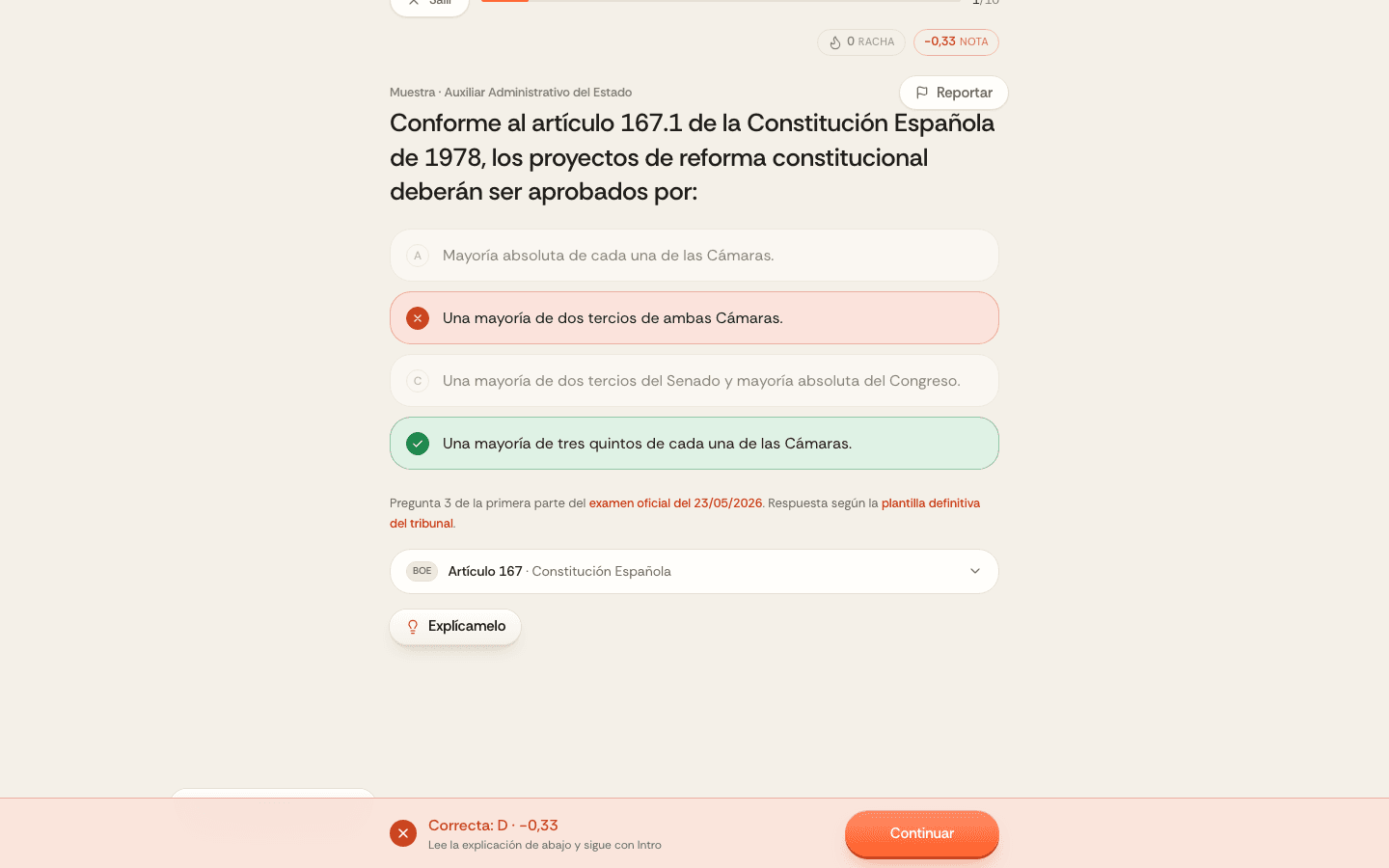
In the exam call for the Cuerpo General Auxiliar de la Administración del Estado (Resolution of 18 December 2025, BOE of 22 December), each wrong answer deducts one third of the value of a right answer and blanks are not penalised. Example for the first part, of 60 questions: with 40 right, 12 wrong and 8 blank, you score 40 minus 12/3, so 36 raw points. The selection board set the pass mark for that part at 29.
One quarter in the Andalusian Health Service
The general rules for the Servicio Andaluz de Salud (Resolution of 22 January 2025, BOJA 17 of 27 January) score the theory exercise with the formula (A minus E/4) times 50/PT, where A is right answers, E is errors and PT is the number of questions. Here each wrong answer costs a quarter of a right one, less than in the Auxiliar del Estado.
When it pays to answer without being sure
With four options and a one-third penalty, a pure random guess is worth zero on average: one time in four you gain 1 and three times in four you lose 1/3. If you can safely rule out one option, choosing among the remaining three is worth +0.11 per question on average. Rule out two and it is +0.33. With a one-quarter penalty, even a pure guess is worth slightly more than zero (+0.06). So the practical rule is to answer when you can rule out at least one option.
Practise the decision, not just the syllabus
Knowing the formula is not enough: you have to decide in seconds whether to answer or leave a blank. Take mock exams with the same penalty as your exam and check afterwards how many points the wrong answers cost you. If they cost a lot, you answer too much. If you leave many blanks you would have got right, you answer too little.
Preparing the Auxiliar del Estado? Continue with How to prepare the Auxiliar Administrativo del Estado exam with official exams
Sources
- Resolución de 18 de diciembre de 2025, Secretaría de Estado de Función Pública (exam calls for AGE corps). BOE no. 306, 22 December 2025, annex I, sections 2.2 and 2.3 (in Spanish).
- INAP, Comisión Permanente de Selección. Information note: pass marks for the single exercise of the Cuerpo General Auxiliar (in Spanish).
- Resolución de 22 de enero de 2025, Dirección General de Personal del SAS, general rules for competitive exams. BOJA 17, 27 January 2025, rule 2.2.2.3 (in Spanish).
How Oporama applies your exam's penalty
Every oposición on Oporama is marked with the formula from its own rules, and the sources page says which gazette it comes from. In the Auxiliar Administrativo del Estado a right answer adds 1, a wrong one subtracts 0.33 and a blank is worth 0, and your score is compared with the pass mark of each part. You see it on every question: when you get one wrong, the score drops right away.