Greek mythology in order: from Chaos to the return of Odysseus
Greek mythology was never one book. It comes from poets and writers across many centuries, and they did not always agree. Still, most retellings follow the same broad timeline, and knowing it makes every single myth easier to place. This is that order, with the ancient text each part comes from.
Creation: Chaos, Earth and Sky
Hesiod's Theogony, from around 700 BCE, is the fullest early account. First came Chaos, then Gaia (Earth), Tartarus and Eros. Gaia bore Uranus, the starry Sky. Uranus kept his children hidden inside the earth, so Gaia made a great sickle of grey flint, and Cronus, the youngest of the Titans, used it to overthrow his father.
The war of gods and Titans
Cronus had been warned that one of his children would overthrow him, so he swallowed each one at birth. Rhea hid the newborn Zeus in a cave on Crete and gave Cronus a stone wrapped in swaddling clothes instead. Once grown, Zeus freed his siblings, and the gods fought the Titans for ten full years. With the Cyclopes, who gave him thunder and lightning, and the Hundred-Handers on his side, Zeus won and the Titans were shut in Tartarus.
The age of the Olympians
Zeus and his brothers divided the world by lot: the sky for Zeus, the sea for Poseidon and the underworld for Hades, as Poseidon recalls in the Iliad. This is the period of most of the stories about the gods themselves: Demeter and Persephone, Prometheus and fire, the loves and quarrels on Olympus.
The age of heroes
Next come the heroes, a few generations before Troy. Perseus beheads Medusa, and his great-grandson Heracles performs the labors. Apollodorus explains why there are twelve: Heracles was set ten, but Eurystheus did not count the Hydra, because Iolaus helped, or the Augean stables, because Heracles asked for payment. Theseus and the Minotaur belong to this age too.
The Trojan War and the Odyssey
The Iliad covers only a few weeks in the tenth year of the war: the anger of Achilles, the death of Hector and his funeral. The wooden horse is not in it. That story is told in the Odyssey and in Virgil's Aeneid. The Odyssey then follows Odysseus on the ten years it takes him to get home to Ithaca.
For the other big pantheon, read Norse gods explained: who they are and how their story ends
Sources
The Greek myths in this order, in MythologyNow
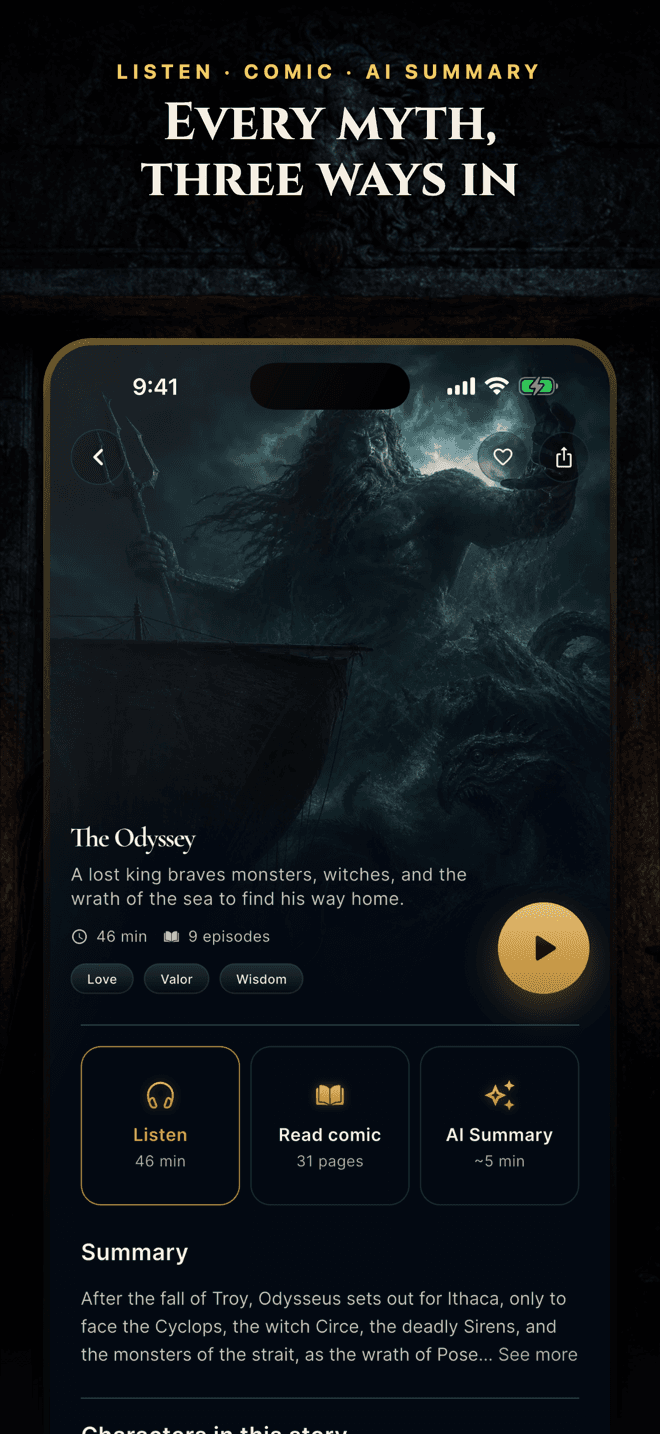
The Greek collection in MythologyNow runs in the same order: Birth of the Cosmos and Rise of Zeus, the Titanomachy, the twelve labors of Heracles, Perseus and Medusa, Orpheus and Eurydice, the Trojan War and the complete Odyssey. Every story is told in episodes of about 5 minutes, and many can also be read as a comic or a short summary.