Norse gods explained: who they are and how their story ends
Most people meet the Norse gods through films and games, and then find that the old stories are stranger and darker. Almost everything we know comes from two books written in Iceland in the 13th century. Here is who the main gods are, according to those books, and how their story ends.
Know where the stories come from
The Prose Edda was written by the Icelander Snorri Sturluson around 1220. The Poetic Edda is a set of older anonymous poems, kept in a manuscript called the Codex Regius from around 1270. Both were written down in Christian Iceland, more than two centuries after its conversion, so they are retellings of older beliefs, not scripture.
Two families of gods
Most of the gods are Aesir: Odin, his wife Frigg, Thor, Tyr, Baldr and Heimdall. A second family, the Vanir, gave Njord and his children Freyr and Freyja. Snorri says that Njord came to the Aesir as a hostage when the two families made peace. The gods live in one of nine worlds, which the poem Voluspa places in the great ash tree Yggdrasil.
Odin and Thor
Odin is the god of wisdom, and he pays for it. He gave one of his eyes for a drink from Mimir's well, and in the poem Havamal he hangs on the windy tree for nine nights to win the runes. Thor, his son, carries the hammer Mjolnir and fights the giants. On a fishing trip with the giant Hymir, he pulls the World Serpent, Jormungandr, up from the sea, and in Snorri's version Hymir cuts the line.
Loki and his children
Loki is the son of a giant but lives among the gods, sometimes helping them and often causing trouble. With the giantess Angrboda he has three children: the wolf Fenrir, the World Serpent and Hel. The gods bind Fenrir with Gleipnir, a fetter made of six impossible things, such as the sound of a cat walking and the roots of a rock. Tyr puts his hand in the wolf's mouth as a pledge and loses it. Later Loki tricks the blind god Hod into killing Baldr with mistletoe.
Ragnarok, and what comes after
At Ragnarok the bound monsters break free. Fenrir swallows Odin, and Odin's son Vidar kills the wolf. Thor kills the World Serpent, walks nine paces and falls dead from its venom. Tyr and the hound Garm kill each other. But the story does not end there: the earth rises again from the sea, green and fair, and some of the gods survive to live on it.
New to the Egyptian gods too? Read Egyptian mythology for beginners: the myths to start with
Sources
- Snorri Sturluson. The Prose Edda: Gylfaginning. Translated by A. G. Brodeur, 1916. Wikisource.
- The Poetic Edda: Voluspo. Translated by H. A. Bellows, 1923. Wikisource.
- The Poetic Edda: Hovamol. Translated by H. A. Bellows, 1923. Wikisource.
- The Poetic Edda: Hymiskvitha. Translated by H. A. Bellows, 1923. Wikisource.
The Norse myths in MythologyNow
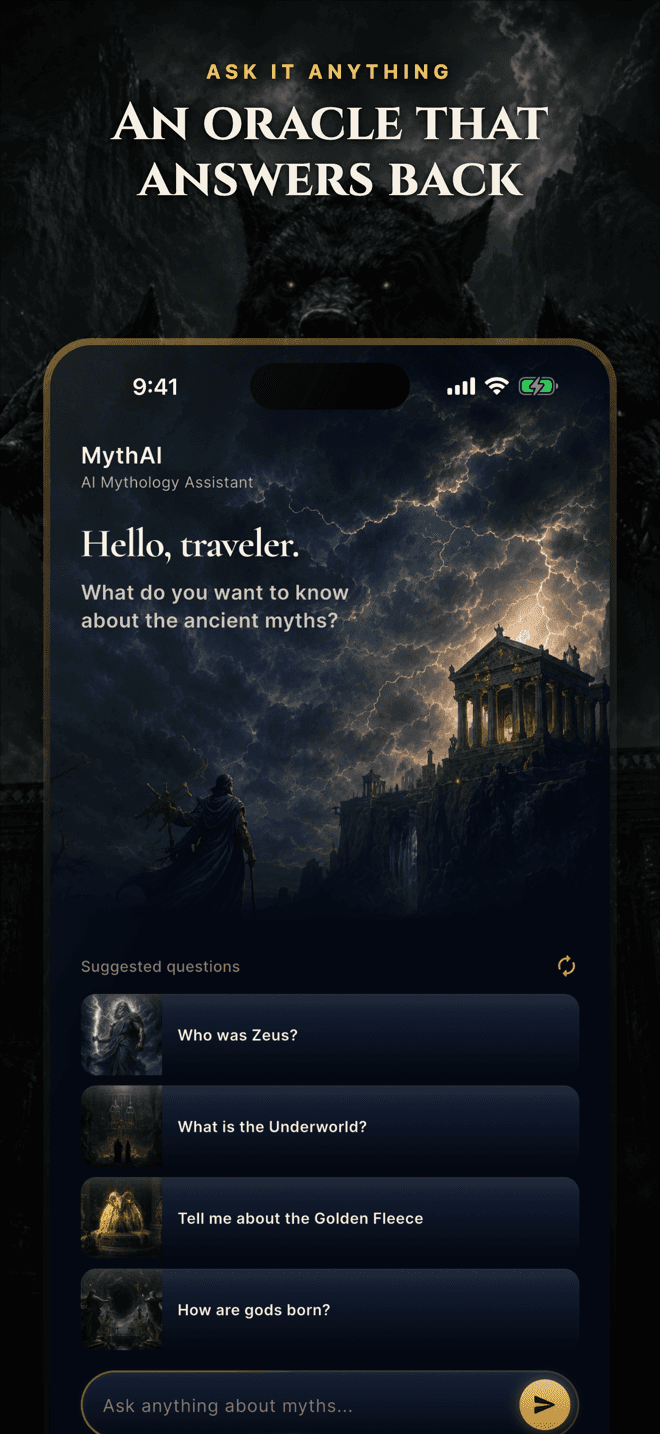
The Norse collection in MythologyNow tells these stories in order: the creation from ice and fire, Odin at the well of wisdom, Thor against the World Serpent, Loki and his children, and the complete Ragnarok. If you lose track of who is who, ask the Oracle in the app, or open the character profiles.