1099 take-home pay: what a contract rate really leaves you
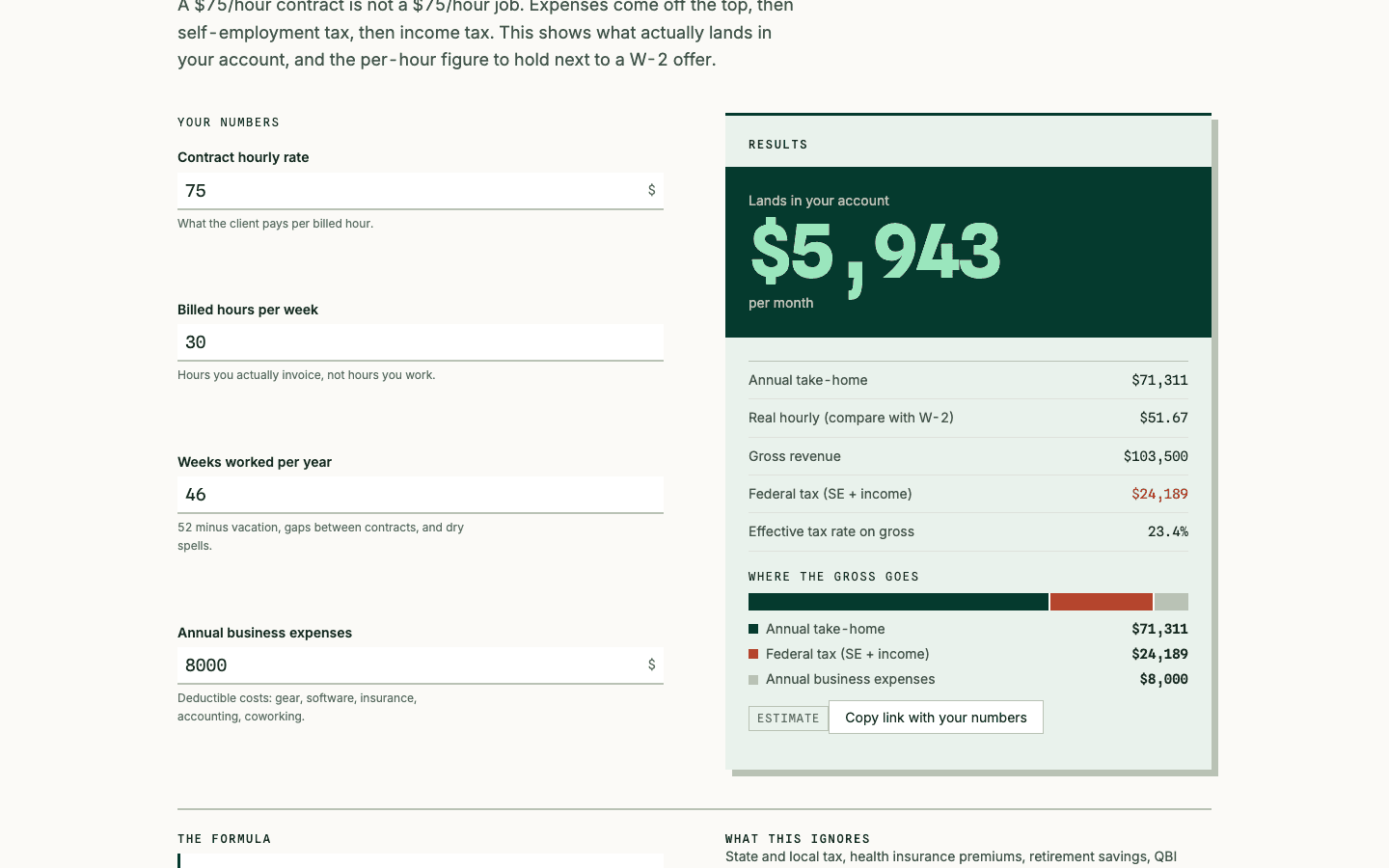
A $75 an hour contract sounds like $156,000 a year, because 75 × 2,080 is 156,000. What reaches your account is far less, and the gap is not a mystery: three cuts stack on top of each other. Here they are in order, with one example carried through.
Count the hours you will bill
Gross is your rate × billed hours per week × weeks worked. At 30 billed hours a week for 46 weeks you sell 1,380 hours, not 2,080. At $75 that is $103,500 of revenue.
Take expenses off before tax
Deductible business costs (equipment, software, insurance, accounting) come off the gross, and tax is charged on what is left: your Schedule C profit. With $8,000 of expenses, the profit is $95,500.
Pay both halves of payroll tax
An employer pays half of an employee's Social Security and Medicare. On a 1099 you pay all of it as self-employment tax: 15.3% of 92.35% of profit, with half of it deductible for income tax. On $95,500 of profit that is about $13,494.
Then the income tax
Profit minus half the self-employment tax and the $16,100 standard deduction (single, 2026) goes through the federal brackets: about $10,696. Federal tax comes to $24,189, which leaves $71,311 a year, $5,943 a month, or $51.67 per billed hour. That is before state tax, health insurance and retirement savings, costs a W-2 employer often covers in part.
Once you know the yearly bill, read Quarterly estimated taxes for the self-employed: dates, amounts and the safe harbor
Sources
The 1099 take-home calculator
Enter your contract rate, billed hours per week, weeks worked and annual expenses. Working Figures returns your monthly and annual take-home, a real hourly figure to hold next to a W-2 offer, gross revenue, federal tax and the effective rate, with a chart of where the gross goes. It runs on the same 2026 engine as the quarterly estimator. For a direct salary comparison there is the W-2 vs 1099 rate calculator, and precomputed take-home pages cover incomes from $20,000 to $200,000.