Quarterly estimated taxes for the self-employed: dates, amounts and the safe harbor
Nobody withholds tax from a freelance invoice, so the IRS expects you to pay during the year, in four installments. Pay too late or too little and an underpayment penalty is added on top. The rules are short once they are in one place.
Check whether you have to pay
The IRS says individuals, sole proprietors included, generally have to make estimated payments if they expect to owe $1,000 or more when they file, after withholding and credits. A freelancer with a real profit and no withholding almost always clears that line.
Put the 2026 due dates in your calendar
April 15, June 15 and September 15, 2026, then January 15, 2027. The periods are not equal quarters. A date that falls on a weekend or legal holiday moves to the next business day. If you file your 2026 return by January 31, 2027 and pay the full balance, you can skip the January payment.
Estimate the tax from profit, not revenue
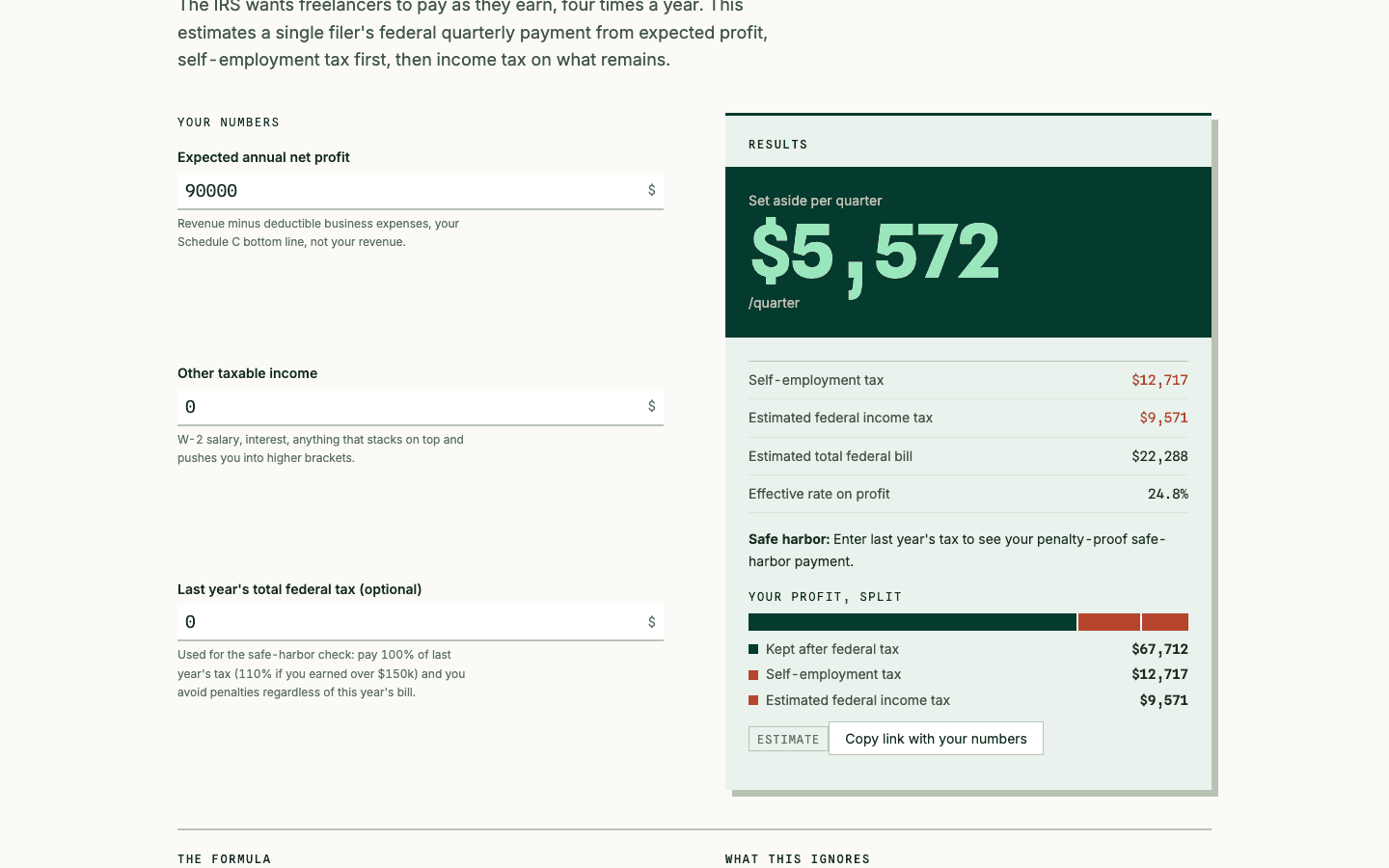
Two federal taxes stack on your net profit. Self-employment tax is 15.3% of 92.35% of profit: 12.4% for Social Security up to the $184,500 wage base in 2026, and 2.9% for Medicare with no cap. Income tax applies to profit minus half of the self-employment tax and the standard deduction ($16,100 for a single filer in 2026). On $90,000 of profit, single, with no other income, that is $12,717 plus $9,571: $22,288 for the year, or $5,572 a quarter, before any state tax.
Use the safe harbor when this year is hard to predict
You generally avoid the penalty if your payments cover at least 90% of this year's tax or 100% of last year's, whichever is smaller. If last year's AGI was over $150,000 ($75,000 married filing separately), the prior-year figure is 110%. With $20,000 of tax last year, $5,000 a quarter keeps you safe; if you end up owing more, you pay the rest in April without a penalty. If your income is falling, 90% of this year's tax can be the smaller payment.
Pay online, or more often if it helps
You can pay through your IRS online account, the other options at IRS.gov/payments, or by mail with Form 1040-ES. Weekly or monthly payments are fine too, as long as enough has been paid by each due date.
To fund those payments from every invoice, read How much to set aside for taxes as a freelancer, from your own numbers
Sources
Your four payments in Working Figures
The quarterly tax estimator takes your expected net profit, any other taxable income and, if you have it, last year's total federal tax. It returns the amount to set aside each quarter, the self-employment and income tax split, your effective rate and a safe-harbor payment. It uses 2026 single-filer constants and says on the page what it leaves out: state tax, the QBI deduction, credits and other filing statuses. The safe harbor calculator handles the 100% and 110% tiers on their own, the estimated tax penalty calculator prices a missed or short payment, and the tax calendar lists every deadline with its source.