One rep max calculator: estimate your 1RM without testing it
Testing a true one rep max means working up to a single you can barely finish. An estimate from a hard set of 3 to 10 reps gets close without the risk, and it is the number most programs base their percentages on. Enter a recent set below.
Unit
215.8 lb
Epley estimate
208.1 lb
Brzycki estimate
Working weights from your Epley estimate
| % of 1RM | Load |
|---|---|
| 95% | 205 lb |
| 90% | 195 lb |
| 85% | 185 lb |
| 80% | 175 lb |
| 75% | 160 lb |
| 70% | 150 lb |
| 65% | 140 lb |
| 60% | 130 lb |
Loads are rounded to the nearest 2.5 kg or 5 lb, the smallest jump most gyms can put on a barbell.
Use a set you could not have repeated
The formulas predict a max from repetitions to fatigue, so the set has to be close to failure. A comfortable set of 5 with two or three reps left in the tank will give you an estimate that is too low.
Epley and Brzycki, the two common formulas
Epley: 1RM = weight × (1 + reps ÷ 30). Brzycki: 1RM = weight × 36 ÷ (37 − reps). They give the same answer at 10 reps. Below 10, Brzycki comes out slightly lower; above 10, slightly higher. For 100 kg × 5, Epley says 116.7 kg and Brzycki 112.5 kg.
Stay at 10 reps or fewer
In a 1997 study of 67 untrained college students, seven of these equations correlated above 0.95 with tested maxes in the bench press, squat and deadlift. The authors note the formulas rest on sets of 10 reps or fewer. Even so, the average error was significant in all but one or two equations for the bench press and squat, and every equation underestimated the deadlift.
Turn the estimate into working weights
The American College of Sports Medicine recommends loads around 60% to 70% of 1RM for 8 to 12 reps for novice and intermediate lifters, and cycling 80% to 100% for advanced lifters. The table under the calculator rounds each percentage to a weight you can load.
Re-estimate every session instead of re-testing
Every hard set gives you a new estimate, so you can follow your strength week by week without a max-out day. Plotting the estimate per exercise shows whether a lift is still moving.
Sources
- Epley B. Poundage Chart. Boyd Epley Workout. Lincoln, NE: Body Enterprises; 1985.
- Brzycki M. Strength testing: predicting a one-rep max from reps-to-fatigue. JOPERD. 1993;64(1):88-90.
- LeSuer DA et al. The accuracy of prediction equations for estimating 1-RM performance in the bench press, squat, and deadlift. J Strength Cond Res. 1997;11(4):211-213.
- American College of Sports Medicine. Progression models in resistance training for healthy adults. Med Sci Sports Exerc. 2009;41(3):687-708.
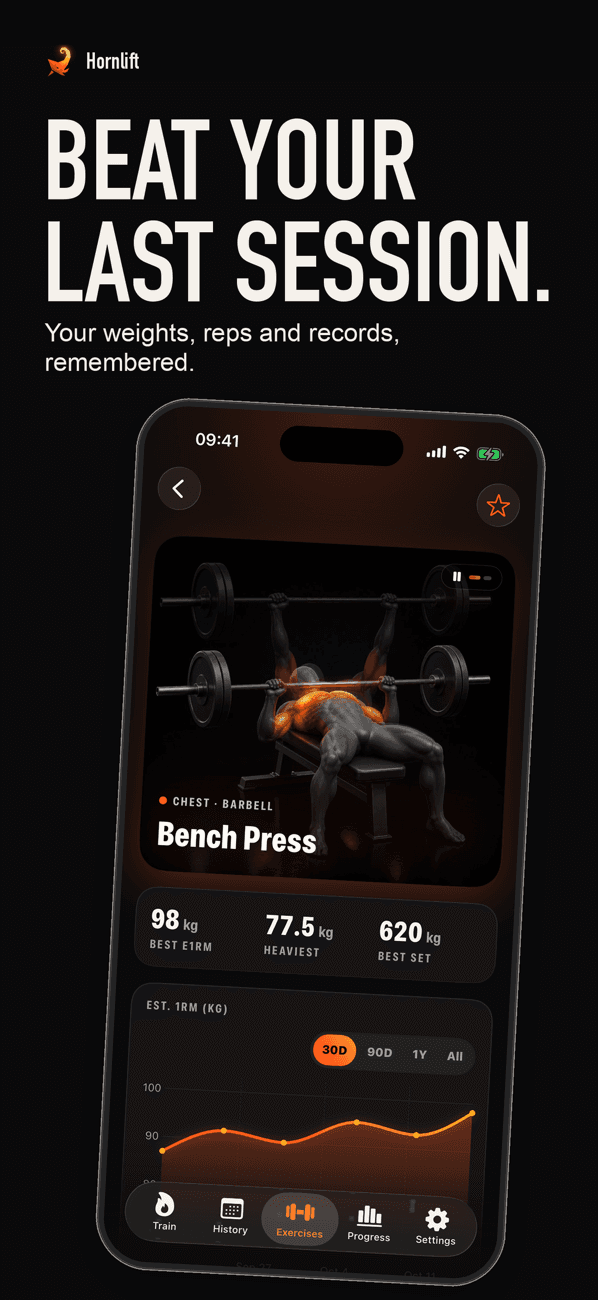
Hornlift tracks your estimated 1RM for you
Hornlift uses the same Epley formula on every set you log. Your best estimated 1RM for each exercise is kept as a personal record and charted over time, next to your heaviest set and best set volume.