Push pull legs routine: a 6-day split with sets, reps and a deload
Push pull legs splits your training by movement: pressing muscles one day, pulling muscles the next, then legs. Run it twice through in a week and every muscle gets trained twice, with a full rest in between. Here is a complete version, and how to run it.
What goes on each day
Push is chest, shoulders and triceps: bench press 4 × 6-8, overhead press 3 × 8-10, incline dumbbell press 3 × 8-12, lateral raise 4 × 12-15, triceps pushdown and overhead triceps extension 3 × 10-12. Pull is back and biceps: deadlift 3 × 4-6, pull-up 3 × 6-10, barbell row 3 × 8-10, face pull 3 × 12-15, barbell curl 3 × 8-12, hammer curl 3 × 10-12. Legs: back squat 4 × 6-8, Romanian deadlift 3 × 8-10, leg press and lying leg curl 3 × 10-12, standing calf raise 4 × 10-15.
Six days or three
Six days a week (push, pull, legs, push, pull, legs, rest) trains each muscle twice. A 2016 meta-analysis found that training a muscle twice a week grew it more than once a week at the same volume. If you can only train three days, run each day once a week and expect slower progress.
Count your weekly sets
The routine above is about 55 working sets per rotation, so about 110 a week at six days. That puts the main muscles above 10 hard sets a week, the point where a 2017 meta-analysis saw more growth than with fewer sets. If you cannot recover, cut sets from the last exercise of each day first.
Add weight with double progression
Keep the weight until every set reaches the top of its rep range, then add the smallest jump and go back to the bottom of the range. For the 6-8 lifts that means 8, 8, 8, 8 before you add weight.
Plan a lighter week
Six hard days a week add up. Every fifth week, halve the sets and use about 80% of your usual weights, with the same reps. You come back fresh and the next week usually feels strong.
For the full progression rule, read Progressive overload: when to add weight, and how much
Sources
- Schoenfeld BJ, Ogborn D, Krieger JW. Effects of resistance training frequency on measures of muscle hypertrophy: a systematic review and meta-analysis. Sports Med. 2016;46(11):1689-1697.
- Schoenfeld BJ, Ogborn D, Krieger JW. Dose-response relationship between weekly resistance training volume and increases in muscle mass: a systematic review and meta-analysis. J Sports Sci. 2017;35(11):1073-1082.
- American College of Sports Medicine. Progression models in resistance training for healthy adults. Med Sci Sports Exerc. 2009;41(3):687-708.
The Push Pull Legs program in Hornlift
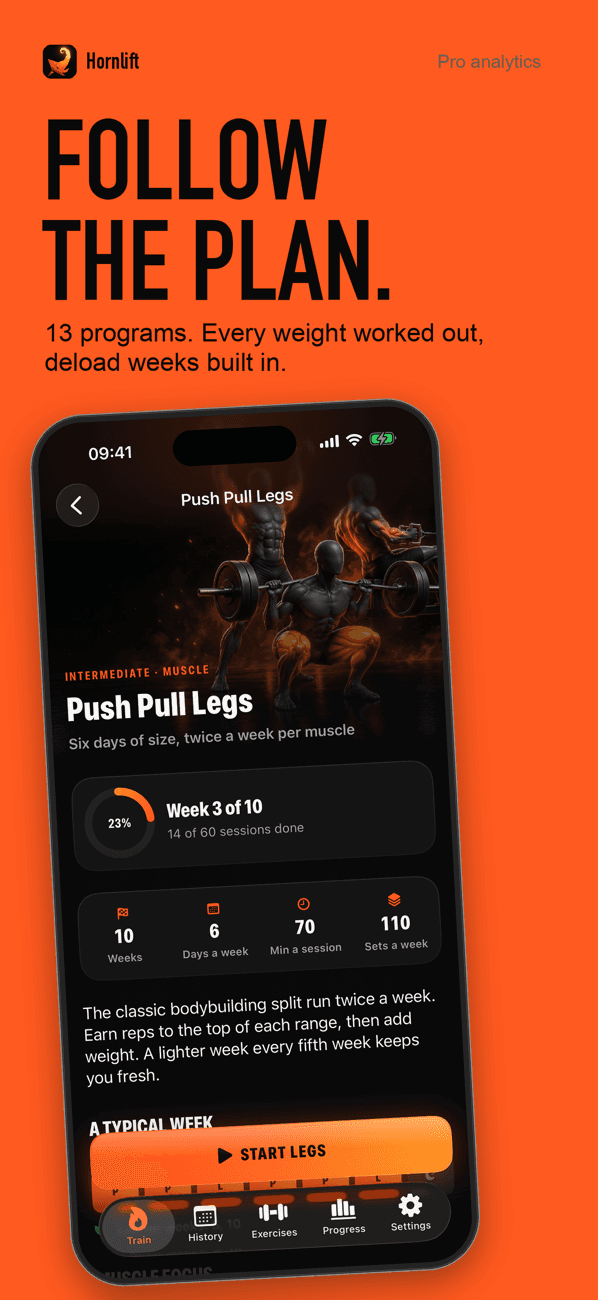
Hornlift Pro has this exact routine as a 10-week program, 6 days a week. Weeks 5 and 10 are lighter weeks with half the sets at 80% of the weight. Each exercise progresses with double progression, and if a lift stalls for three sessions, Hornlift drops it 10% and builds it back. Advanced lifters also get a free Push, Pull and Legs set of starter routines when they set up the app.