Progressive overload: when to add weight, and how much
Your body adapts to the work you give it, so the work has to grow for you to keep getting stronger. That is progressive overload. The hard part is deciding when to add weight and how much. Enter your last session below to see what to do next.
Unit
135 lb
Next session
11
Target reps per set
Not every set reached the top yet: keep the weight and beat your weakest set by one rep.
When you do add weight, ACSM's 2% to 10% range is 140 lb – 145 lb
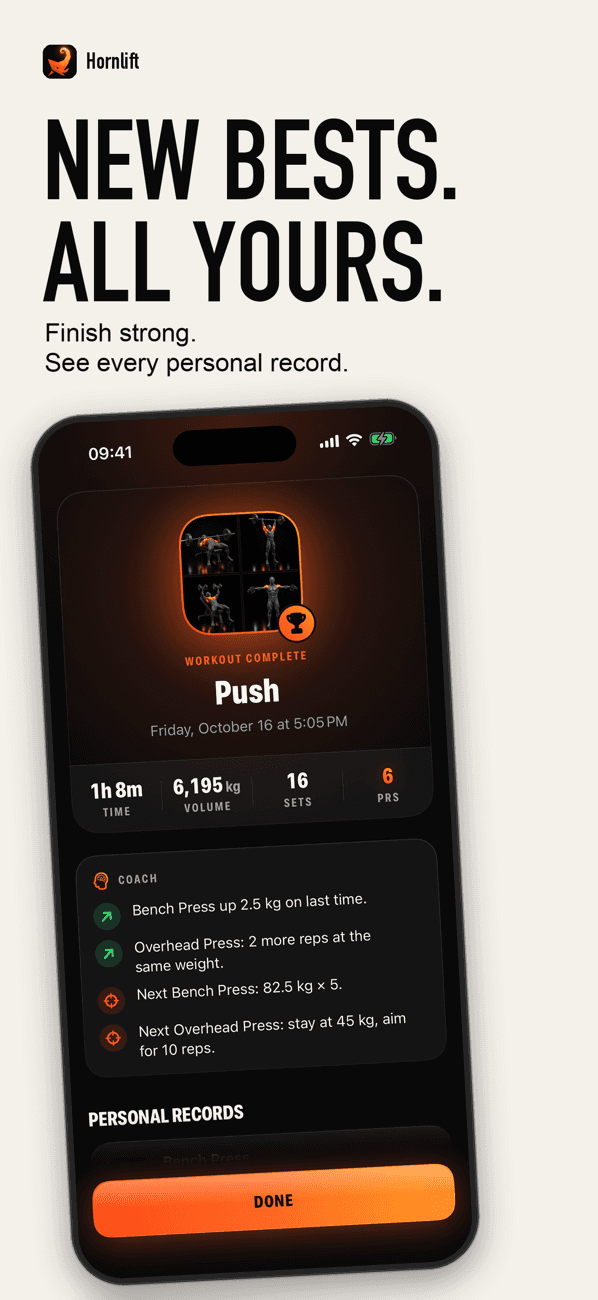
This is the double progression rule Hornlift uses for its next-session suggestions, minus the effort (RPE) adjustments the app makes when you log them.
The rule the research gives
The American College of Sports Medicine recommends a 2% to 10% increase in load once you can do the current weight for 1 or 2 reps more than your target, on two sessions in a row. For a 60 kg lift that is 61.2 to 66 kg, so in practice the next step is 62.5 or 65 kg.
Double progression: reps first, then weight
Pick a rep range, such as 8 to 12. Keep the same weight and add reps until every set reaches 12. Then add the smallest jump your gym allows and drop back to 8. Going from 60 kg for 3 × 12 to 62.5 kg for 3 × 8 is a 4.2% increase, inside the ACSM range.
Beat your weakest set, not your best one
If your sets went 12, 11 and 10, you are not ready for more weight. Aim for 11 reps on every set next time. The weakest set is the one holding the weight back.
Choose the range for your goal
ACSM suggests an 8 to 12 rep range for beginners. For strength, intermediate and advanced lifters use 1 to 12 reps over time, with an emphasis on heavy sets of 1 to 6. For muscle size, the emphasis is on 6 to 12.
Train each muscle at least twice a week
The Physical Activity Guidelines for Americans recommend muscle-strengthening activity for all major muscle groups on 2 or more days a week. ACSM puts beginners at 2 to 3 days a week. More sessions give you more chances to progress.
Sources
Hornlift does the bookkeeping
Progressive overload only works if you know exactly what you did last time. Hornlift fills in your last weights and reps on every set. With Hornlift Pro it suggests the next weight and rep target for each exercise, using the double progression rule from this guide.